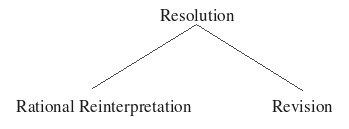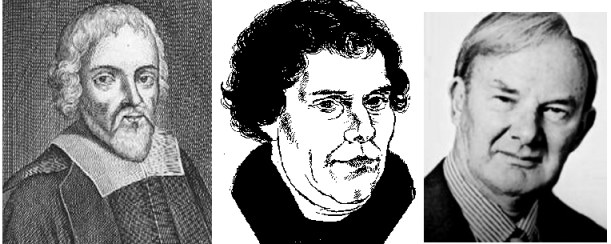
Three famous Revisers: Socinus, Luther, and Hick. When it comes to apparently contradictory claims in theology, there’s more than one way to Resolve the apparent inconsistency. The more popular way nowadays among Christian philosophers is what I called Rational Reinterpretation. The other way to Resolve? Revision. We’re faced with P, Q, and if P then [...]
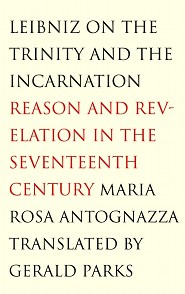
Maria Rosa Antognazza teaches at King’s College London, where she also directs the Centre for the History of Philosophical Theology. She has written a highly praised forthcoming intellectual biography of the great Leibniz. After the break is my review of her book pictured above. The review is forthcoming in Religious Studies. Bottom line: Leibniz employs [...]
Hombre…RUN!!!! Enthusiastic positive mysterians tend to be complacent traditionalists about Bible interpretation – that is, people who are pretty sure that their Christian group (e.g. Catholicism, Reformed Christianity, or maybe simply small-c catholicism) has got the Bible (generally) right. There is a reason for this. The reason is that if you’re trying to reason your [...]
Is that you, Lord? (image credit) A Letter of Resolution concerning the Doctrines of the Trinity and the Incarnation is an anonymous tract, published in 1693 as the lead-off tract in this famous collection (the successor to this one). Although it is anonymous, I’m fairly sure that it’s by Anglican minister Stephen Nye (d. 1719), [...]
“When the LORD finished speaking to Moses on Mount Sinai, he gave him the two tablets of the Testimony, the tablets of stone inscribed by the finger of God.” Ex. 31:18 Once upon a time, there was a smallish branch of Christians, now nearly forgotten to history, called the Fingerites, inhabitants of Obscurantia (formerly part [...]
Why that’s positively negative! If you defend a problematic doctrine as a Mystery, you’re asserting that it to some degree lacks what I call “understandable” content. “Understandable” content is a proposition (thought, claim) that positively seems consistent to you. A claim may fail to be understandable for one of two reasons.
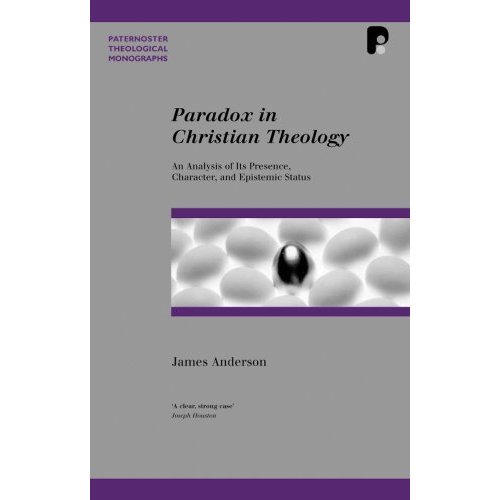
MACRUE!… Gesundheit Man, this is getting to be a long series. This installment is a book review I’ve written of philosophical theologian James Anderson’s Paradox in Christian Theology: An Analysis of Its Presence, Character, and Epistemic Status. It is forthcoming in the philosophy journal Faith & Philosophy, and is posted by the kind permission of [...]
Roll up, folks. We now move one the fourth R – what I call Mysterian Resistance (or Mysterianism). The Resistor is resisting the pressure to resolve the apparent contradiction, i.e. changing one of the apparently contradictory beliefs. Unlike the Redirector, the Resister doesn’t ignore the apparent inconsistency. And unlike the Resolver, he doesn’t think there’s [...]
Your average theologian’s response to recent Rational Reinterpretations. Let me take four recent books off my shelf by current theologians. Now I’ll search through them to see if they have any reference at all to some of the more important Rational Reconstructions in the last 25 years or so, namely: Tom Morris’s (1986, 1989) or [...]
Can’t we all just get along? One last problem for Resolution through Rational Reconstruction: the new-fangled theory (or if you like, way of understanding the Doctrine) is invariably controversial, in the following sense: it involves metaphysical claims such that some thinkers will consider them false and impossible, and others not. The more you think about [...]
Whew! That was close! Many recent Christian philosophers have offered what I call Rational Reconstructions of apparently contradictory doctrines such as the Trinity and the Incarnation. Though I’m presently exploring criticisms of such views, let me emphasize that I don’t see anything wrong with what they’re doing, and I think that people with philosophical skills [...]
Yes, this is the real thing. Really. And it can be yours for a mere $50. Last time we highlighted one problem with Resolution through Rational Reinterpretation – often, only a metaphysician could love the new-fangled (but precise and seemingly consistent) version of the Doctrine in question. A second concern is that many believers think [...]
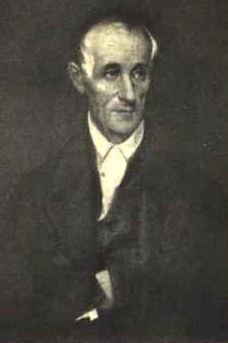
Moses Stuart (1780-1852), professor at Andover Theological Seminary, and NOT a fan of Rational Reconstruction (image credit) What, if anything, is wrong with with the strategy of Resolution through Rational Reinterpretation? And why are most theologians so cold towards this strategy, while most Christian philosophers love it? Consider this quote by Moses Stuart on one [...]
This brings the total of R’s to 6. Wish I could say there weren’t more coming! We’ve looked so far at two ways Christians may respond to apparently contradictory doctrines: Redirection and Restraint. We now move on to a third strategy: Resolution. In brief, the Resolver holds that the apparent contradiction can be banished, made [...]
Good old, mass-murdering, cheese-burger-scarfing Uncle Joe. (image credit) A story about implicit faith… Once upon a time, there was a virtuous and patriotic Russian peasant named Georgy. Georgy lived a simple life among simple people, in a village so far out in the boondocks of the USSR that World War II – what Russians call [...]
Who are you calling dumb? (image credit) We’re exploring the response of Restraint – when confronted with an apparently contradictory doctrine, might it not be a good idea for the believer to simply admit that she doesn’t know what it means? Last time we looked at the idea of “implicit faith”. What, if anything, is [...]
Nothing objectionable in there… One way to deal with an apparently contradictory doctrine in your religion is the response of Restraint. There’s a connection here, with the medieval Catholic doctrine of “implicit faith”, so I thought I’d explore it a little, and in my next post, I’ll apply this to the issue of Restraint in [...]
Don’t ask me what this doctrine means… I only believe it. Last time we briefly explored Redirection, the first of our four ways to respond to apparent contradictions in theology. The response of Restraint is a little more reasonable. This person realizes that a certain way of understanding, say, the doctrine of the Trinity, seems [...]
The smell of this will get you off the trail… Last time we briefly distinguished four ways Christians respond to apparent contradictions in theology. Here, we look at what I call Redirection. When confronted with an apparently contradictory doctrine X, the Redirector changes the subject. She says something to direct your attention away from X, [...]
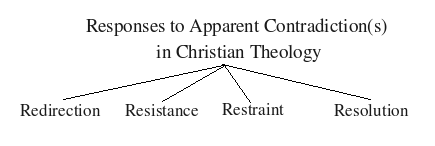
This chart has been brought to you by the letter “R” and the number “4″. In this series I’ll describe 4 basic ways Christian thinkers respond to apparent contradictions in theology. I don’t claim these are complete. Maybe ya’ll can help me clarify and add to this scheme. I’ve been working for a while on [...]