Brandon’s Siris blog has recently completed 6 years – it has surely outlived 99.9% of blogs, and is older than trinities, which is 4 this summer! Congrats, Brandon! In a recent post Brandon takes issue with my recent appeal to the principle that “if every F is a G then there cannot be fewer Gs [...]
Call me a satisfied customer – I had a great time at the Eastern Regional Conference of the Society of Christian Philosophers this weekend. Thanks to Patrick Toner and Wake Forest University for their great hospitality! The program was very strong. To mention just a few sessions: Paul Herrick present a paper analysing and endorsing [...]
Thanks to Ed Feser for some interesting dialogue on the topic of mysteries in Christian theology. This post is just a bunch of miscellaneous responses to his thoughts posted last week, here and here. As he mentioned, Ed and I knew each other briefly as students at what is now called Claremont Graduate University. I [...]
Richard of St. Victor is well known for talking about love, and how awesome it is. It might surprise a few people who have only read the popular English translation of Book 3 (the love/ethics? book) that On the Trinity contains six books. The English translation has brought attention to what some contemporary (continental-esque) philosophers [...]
Up to this point in Book 3 Richard has told us several things about love (caritas). We have wondered at his saying there isn’t a perfectly good person if he doesn’t love. We have sorted through some necessary conditions for love such that we wonder whether a perfectly good person p must love another person [...]
Can’t we all just get along? One last problem for Resolution through Rational Reconstruction: the new-fangled theory (or if you like, way of understanding the Doctrine) is invariably controversial, in the following sense: it involves metaphysical claims such that some thinkers will consider them false and impossible, and others not. The more you think about [...]
Is Ned in trouble? Here’s a quick post to wrap up the series on Brower’s and Rea’s constitution theory of the Trinity. First, it’s striking how original and self-consistent their approach is. It is rare to find something this new, and this well thought through on such an old topic. They’ve carefully carved [...]
Like about everything else these days. In this post I want to explore what to me is the oddest and hardest part to grasp of the constitution trinitarianism. When I first read their paper, I thought they thought God was a stuff – that is, that the term “God” referred to a certain [...]
JT Paasch is a graduate student at Oxford, he’s originally from Utah. He earned a M.Div at Trinity Evangelical Divinity School (under Kevin Vanhoozer), then went to Oxford to work with Richard Cross on medieval trinitarian theology. His doctoral thesis is titled ‘The Logic and Metaphysics of the Trinity according to William of Ockham’. I’ve [...]
“Come on, you tired little brain – don’t fail me now.” (No, I don’t really blog naked – serious thought requires having at least your underpants on.) Joseph Jedwab does an excellent job (here, comments 3 & 4) pressing me for details, and taking a shot at defending the Brower and Rea theory. I [...]
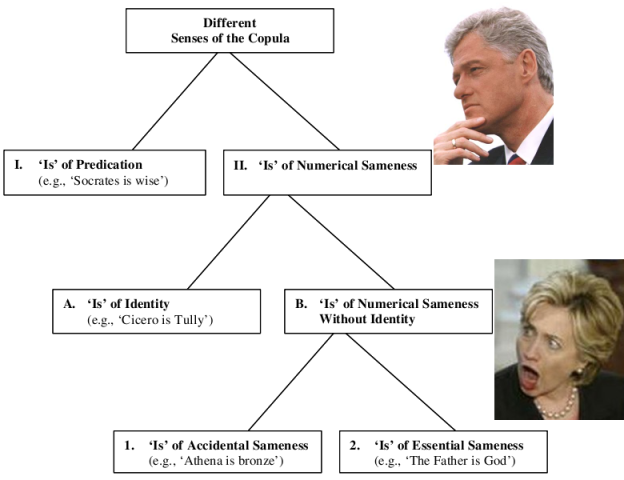
Is the Son God? In the immortal words of Bill Clinton, “It depends on what the meaning of the word ‘is’ is.” Brower and Rea suggest the following classification of meanings of “is” (in logic, “is” is called “the copula” – that which connects the subject and what’s being said of that subject). Um, no [...]
“Rerun time!” Several gents have already blogged about our present theory, so for those of you looking for more, or for a different angle: Matthew Mullins (here, here, and here) Brandon J.T. Paasch (cf. his comments here, #6) Did I leave anyone out? Technorati Tags: Jeff Brower, Mike Rea, constitution trinitarianism, numerical sameness
In the same issue of Faith and Philosophy (22:1, Jan 2005, 77-86) Bill Craig has a critical response piece. (Available online here.) First, he gives a nice and clear summary of their article, more complete than the one I gave last time. Then he proceeds to object. As with most philosophical theories, when you start [...]
The next theory up to bat is by philosophers Mike Rea of Notre Dame and Jeff Brower of Purdue University. In some ways Mike reminds me of his mentor Al Plantinga – a tall guy you don’t want to argue against unless you absolutely have to. He’s published many articles in metaphysics and philosophy of [...]
Now, on to the Fourth Lateran Council, convened by Pope Innocent III in 1215. This council, considered the 12th “ecumenical” council, was one of the all-time most important councils, which strongly shaped catholicism in the “high†middle ages. It was called, in part, to get another crusade going, after some crusading failures and set-backs. The [...]
The so-called Athanasian Creed (also known by the Latin words it begins with, Quicumque vult) is considered by many to be the very definition of “the” orthodox doctrine. It is of uncertain origin, although many readers think it has a strongly Augustinian flavor (which if true shows it is not from Athansius himself, who died [...]
How many times have you seen one of these offered as an explanation or illustration of the doctrine of the Trinity? There’s a really neat article about these here, complete with some links to real medieval examples. Basically, this sort of Shield of Faith (Latin: scutum fidei) diagram seems to have originated in the high [...]