Philosophy Compass is a unique philosophy journal which only publishes survey articles, pieces which aim to summarize recent work. Its aim, as editor Brian Weatherson explains, is to enable people to keep up with a vast, overspecialized, fast-moving, and only somewhat accessible world of philosophical research. What’s more exciting – they sell the pdfs of [...]
Kudos to the team at the Internet Encyclopedia of Philosophy, for their recent radical re-design, done by Josh D. May. Notable improvements include a nice print-friendly page feature, and the entries sorted by topic. Here are the Philosophy of Religion ones. their new entry “Incarnation”, by University of Wisconsin Madison PhD David Werther, who teaches [...]
Up to this point in Book 3 Richard has told us several things about love (caritas). We have wondered at his saying there isn’t a perfectly good person if he doesn’t love. We have sorted through some necessary conditions for love such that we wonder whether a perfectly good person p must love another person [...]
Your average theologian’s response to recent Rational Reinterpretations. Let me take four recent books off my shelf by current theologians. Now I’ll search through them to see if they have any reference at all to some of the more important Rational Reconstructions in the last 25 years or so, namely: Tom Morris’s (1986, 1989) or [...]
Can’t we all just get along? One last problem for Resolution through Rational Reconstruction: the new-fangled theory (or if you like, way of understanding the Doctrine) is invariably controversial, in the following sense: it involves metaphysical claims such that some thinkers will consider them false and impossible, and others not. The more you think about [...]
This brings the total of R’s to 6. Wish I could say there weren’t more coming! We’ve looked so far at two ways Christians may respond to apparently contradictory doctrines: Redirection and Restraint. We now move on to a third strategy: Resolution. In brief, the Resolver holds that the apparent contradiction can be banished, made [...]
Davis: “Take that, Brian.” (image credit) Happy Valentines Day! What an appropriate day to discuss what it means to be “perfect in love”! Stephen T. Davis is a much-admired veteran Christian philosopher, who has long taught at Claremont McKenna College in lovely Claremont, in southern California. Many have read his Logic and the Nature of [...]
Swinburne sez: Two thumbs up for the social analogy! Richard Swinburne is an Emeritus professor at Oriel College, Oxford University, and is widely considered one of the greatest living Christian philosophers. He’s done original work in philosophy of science, epistemology, philosophy of mind, and general metaphysics, but is perhaps best known for his work in [...]
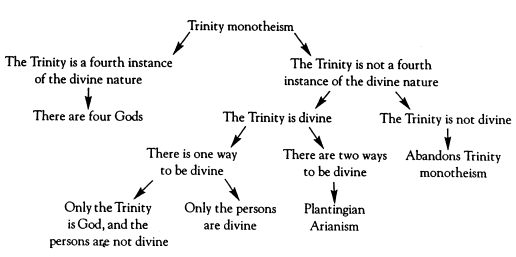
In the words of Moreland and Craig, We turn finally to Trinity monotheism, which holds that while the persons of the Trinity are divine, it is the Trinity as a whole that is properly God. If this view is to be orthodox, it must hold that the Trinity alone is God and that the Father, [...]
To fully understand a philosophical theory, one needs to understand not only the content of it, but the reasons for which it is held. This is why I’m patiently going through how Moreland and Craig reject what they see as the competing Trinity theories, before giving their own. As we’ve seen, they consider themselves to [...]
Before going into objections to “Trinity Monotheism”, I thought it’d be a good idea to say a bit more about their long, meaty chapter in which they (eventually) set out their own theory, in this book. This’ll take a couple of posts, and we’ll allow time for discussion between them. Theologians in particular should find [...]
Returning from my travels, it seems I’ve recently received two issues of Faith and Philosophy, dated Oct 2006 and Jan 2007. There are several bits that may be of interest to readers of this blog.
I’m very pleased to introduce Joseph Jedwab, who has some interesting comments on Moreland’s and Craig’s understanding of the Trinity. I haven’t had the privilege of meeting him, but given how he spells “center”, I gather he’s English. Joseph is currently teaching philosophy and finishing his dissertation at Oriel College of Oxford University, on the [...]
It turns out that Brian Leftow, whose work on the Trinity was the subject of a recent 4 part critical exposition here at trinities, is just about to publish some further thoughts on the subject, in this book, currently slated to come out in March 2007. Further, his chapter there is on the exact issue [...]
Two installments ago, we looked at Brian Leftow’s setup of the issue, and last time we surveyed his distinctive “Latin” trinitarian theory. This time, we’ll wrap it up. A rather obvious and potentially serious objection to Leftow’s theory is that it makes the doctrine of the Trinity out to be modalism, for plainly, in his [...]
Last time, we saw the set-up from Leftow. He’s aiming at orthodoxy, which to him means theorizing in the tradition of the great medieval Latin-speaking theologians. He’s spent a good amount of ink defending the consistency of supposing that a person might travel back to the past, so that she, as it were, acts together [...]
Brian Leftow’s “A Latin Trinity” (Faith & Philosophy 21:3, July 2004, 304-33) is a theory of the Trinity which aims to be squarely in the tradition of “Augustine, Boethius, Anselm and Aquinas”. (304) He also cites the Athanasian creed and the one from Toledo in 675 as well. I’m going to treat this challenging article [...]
Brian Leftow is recognized as one of the most important living Christian philosophers. Formerly of Fordham University in NYC, he now holds the prestigious Nolloth Chair of the Philosophy of the Christian Religion at Oriel College, Oxford. See Trent Dougherty’s comments here for a list of some of his publications. In person, Leftow is very [...]
Now, on to the Fourth Lateran Council, convened by Pope Innocent III in 1215. This council, considered the 12th “ecumenical” council, was one of the all-time most important councils, which strongly shaped catholicism in the “high†middle ages. It was called, in part, to get another crusade going, after some crusading failures and set-backs. The [...]
Over at Faith and Theology a theologian lists what he views as the ten most important latter-day books on the Trinity. An interesting thing about this list is that it shows the radical divide between philosophers (philosophy of religion specialists, philosophical theologians) like me, and (theologically trained) theologians. None of these books has been big [...]