Skip to content

Heresy & Orthodoxy

Dealing with Apparent Contradictions: Part 16 – Mysterious Interpretations

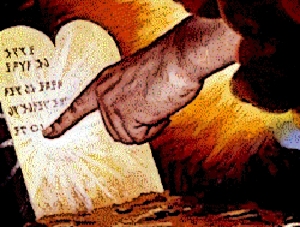
“When the LORD finished speaking to Moses on Mount Sinai, he gave him the two tablets of the Testimony, the tablets of stone inscribed by the finger of God.” Ex. 31:18 Once upon a time, there was a smallish branch of Christians, now nearly forgotten to history, called the Fingerites, inhabitants of Obscurantia (formerly part of the Roman Empire). Although they put their point in… Read More »Dealing with Apparent Contradictions: Part 16 – Mysterious Interpretations

Heretical “trinitarians” – evolution of a word

Following up on the previous post – the word “trinitarian” may be an adjective or a noun. The Oxford English Dictionary lists four adjective meanings: (here’s my editing of relevant parts of their entry, emphasis added) 2. Theol. Relating to the Trinity; holding the doctrine of the Trinity (opp. to Unitarian). In early use, Trinitarian heretic, one holding heretical views as to the Trinity: 1656… Read More »Heretical “trinitarians” – evolution of a word

Dealing with Apparent Contradictions: Part 9 – Rational Reinterpretation, cont.


Yes, this is the real thing. Really.
And it can be yours for a mere $50.

Last time we highlighted one problem with Resolution through Rational Reinterpretation – often, only a metaphysician could love the new-fangled (but precise and seemingly consistent) version of the Doctrine in question. A second concern is that many believers think this “new version of” the Doctrine just ain’t that doctrine at all, but a knock-off – something similar, but different, and moreover, not genuine.

Consider these pronouncements of the First Vatican Council of 1869-70:

…that meaning of the sacred dogmas is ever to be maintained which has once been declared by holy mother church, and there must never be any abandonment of this sense under the pretext or in the name of a more profound understanding.Read More »Dealing with Apparent Contradictions: Part 9 – Rational Reinterpretation, cont.

Is Allah God? Goofus and Gallant, Grok and Sophie

Is Allah God? Are Christians and Muslims talking about (numerically) the same God? We’ve previously linked and joined in with discussions with Jeremy Pierce and with Kevin Corcoran. To further the discussion, I present a tale to explain why it may matter less than you think whether or not the words”God” (used by Christians) and “Allah” (used by Muslims) refer to the same being. A… Read More »Is Allah God? Goofus and Gallant, Grok and Sophie

Derivation vs. Generic Theories – part 6: Issues for the Generic View (JT)

“And the best thing is, we can take these blocks apart!”

In the last post, I introduced the ‘generic view’ of the trinity, namely the claim that Divinity (that which makes the divine persons God/divine) is shared equally by all three persons and so does not belong to any one divine person more than another. In this post, I would like to highlight some of the issues faced by a generic view.

My point of departure is modern day criticism of the generic view such as that of Colin Gunton and John Zizioulas (to name just a few). These authors are not, in my opinion, the most philosophically astute critics, but nevertheless, they do highlight some of the issues relevant for the generic view.

Read More »Derivation vs. Generic Theories – part 6: Issues for the Generic View (JT)

Derivation vs. Generic Theories – part 5: The Generic View (JT)

“Gee Hank, it sure is swell that communism won out.
This house belongs to all of us!”

In the last post, I pointed out some of the problems faced by an Athanasian sort of derivation view. If you found such problems to be decisive, then alternatively you could opt for a generic view. In this post, I would like to introduce the generic view.

As I mentioned in the first post, the generic view claims that Divinity belongs equally to the three persons, similar to how three people might jointly own the same house. Divinity thus belongs to no one divine person any more than another. The generic view (let’s call this GV) rejects DV in favor of this:

(GV) Divinity belongs equally to each divine person.

For both the derivation and the generic views of the trinity, Divinity is an entity that’s shared by the persons. On (the Athanasian version of) the derivation view, this shared entity just is the Father, but on the generic view, this shared entity is not the Father. The Father isn’t shared, Divinity is.

Read More »Derivation vs. Generic Theories – part 5: The Generic View (JT)

your most important Trinity questions wikified

Hi Everybody?
Trinity? Suuuure – I know all about those things!

I’ve always been interested in not only what intellectuals think about the Trinity, but also about what ordinary Christians think. Thus, this is an interesting find – five helpful wikites step in to wiki-answer the following important questions:

WikiAnswers – What is the trinity and could you be a Christian and not believe in the trinity

I’ll save you some trouble, distilling the answers down into 80-proof folk-wisdom, taking the second question first. Read More »your most important Trinity questions wikified

BBC Radio Discussion & an Australian magazine on Nicea

What’s up with that weird Angel/bird/snake thing? Is that supposed to be Arius? At BBC – Radio 4 In Our Time – The Nicene Creed – A somewhat gassy and academic but nonetheless listenable discussion. Here’s the Real Audio file link. (I thought I listened to this in another audio format, but I can’t find any such files at the moment.) Then we’ve got “Great… Read More »BBC Radio Discussion & an Australian magazine on Nicea

Derivation vs. Generic Theories – part 4: Problems for a Derivation View (JT)

Q stunned

“You were filming that?”

In the last post, I explained that for Athanasius’s version of the derivation view, when the Father generates the Son, the Father shares his substance with the Son. That means, I took it, that the Father himself becomes a constituent in the Son, similar to the way that a lump of bronze is a constituent in a bronze statue.

One of the things Athanasius wants to do with this idea is explain how the Son is divine/God. The basic idea is that the Father shares his substance, i.e., Divinity, with the Son, and so the Father shares his properties with the Son. That is, to put it the other way around, the Son inherits properties from the Father. This is supposed to account for how the Son gets divine properties. However, this is where we start to run into problems.

Read More »Derivation vs. Generic Theories – part 4: Problems for a Derivation View (JT)

Derivation vs. Generic Theories — part 3: The Derivation View (JT)

Stark Trek - Q

Now Q comes with spring arm action
and dyno bud (optional)!

The Nicene Creed claims that

(Q) The Son is begotten from the substance of the Father.

The term ‘begotten’ is just an older English term for ‘generated’. In the ancient world, ‘generation’ was a technical term for biological reproduction (e.g., when humans make baby humans, when trees make baby trees, and so on). In this post, I want to describe how Athanasius takes Q to imply a derivation view of the trinity.

Read More »Derivation vs. Generic Theories — part 3: The Derivation View (JT)

Derivation vs. Generic Theories — part 2: Arianism and the Trinity (JT)

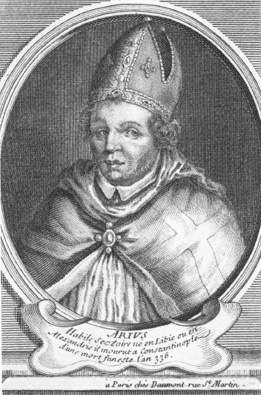
Arius

“I hate wearing this stupid hat.
They didn’t make me a bishop anyways.
At least the cape’s pretty cool.
It’s got St. George’s Cross going on.”

In my last post, I gave some basic definitions for the ‘derivation view’ and the ‘generic view’ of the Trinity, and I said that the historical background for the ‘derivation view’ rests in the Nicene Creed’s claim that

(Q) The Son is begotten from the substance of the Father.

Of course, the meaning of ‘from the substance of the Father’ is not exactly clear, not in a philosophical sense anyways. What exactly is Q supposed to mean? In this post, I want to explain what one interpreter, namely Athanasius, felt was at stake with Q.

Read More »Derivation vs. Generic Theories — part 2: Arianism and the Trinity (JT)

Linkage: Pruss on liberal theology (Dale)

You tell ’em, Joe. An interesting post & discussion: Alexander Pruss’s Blog: Liberal theology I think a lot of liberal theologians don’t have a “high view of reason” – many (not all) of them strike me as lazy drifters on miscellaneous intellectual currents. e.g. Has anyone’s reason really revealed to them, so to speak, that miracles don’t happen, or even that it’s irrational to believe… Read More »Linkage: Pruss on liberal theology (Dale)

Reader Question About Modalism


Ice, ice, baby. (image credit)

A reader emailed me this question, and I thought others would be interested in my (attempt at) an answer. Also, this is a good chance to review and summarize some of my previous postings on modalism.

I was wondering if you could read [the following] and tell me what I was believing? (I think it might have been a form of Modalism) Also, I search everywhere and find that Modalism is wrong, but no explanations specifically why. Can you help me out on some links explaining that?

I used to believe there was one God. He sometimes is called Father, sometimes called Jesus, and sometimes called the Holy Spirit. And sometimes called all at the same time. Read More »Reader Question About Modalism

HoG: “What does it mean to say the Father is ungenerated?” (Scott)

paternity.jpg


“Is there any Son who does not cause His Father to become a Father and vice versa?”

Here I wish to briefly summarize what I take to be Henry’s position on the question: is the Father constituted by the (personal) property of being ‘ungenerated’ (ingenitum)? Henry’s discussion of this comes from his Summa Quaestionum Ordinariarum 57.1.

Henry engages in a lengthy discussion of ways the word ‘ingenitum’ (not generated) or ‘innascibile’ (not able to be born) can be predicated of the Father, whether negatively, privately, or positively. The upshot of these distinctions is to ask about the precise nature of this property ‘ungenerated’. Is it saying what the Father is not (negation), or is it saying the Father lacks some further property and is potentiality to receive some new property (privation), or is it saying there is some positive property the Father really is constituted by?

Henry rejects predication of the property ‘ingentium’ to the Father by negation and by privation; instead he opts for predication of a positive property. What then is this positive property that the Father has/is?

Read More »HoG: “What does it mean to say the Father is ungenerated?” (Scott)

The Latin Trinity Chart 2 – a version of FSH modalism

 Let’s try this again.

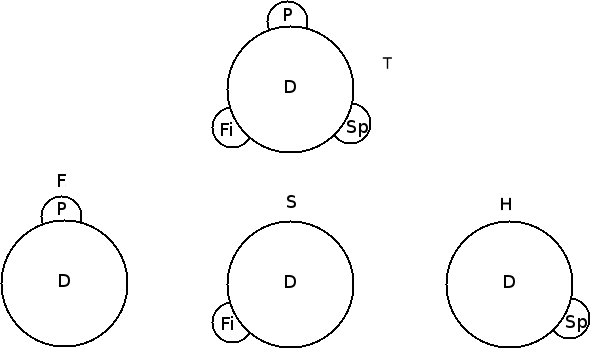
Here’s a second application for my Latin Trinity chart (see the first post for what the letters designate). Let’s say that a state of affairs is a thing/substance having a property at a time or timelessly.

The “persons” here are just modes of D, that is, states of affairs involving D. So the Son just is D having Fi. And the Father just is D having P. And the Holy Spirit just is D having Sp. Regarding each of F, S, and H, each of them “just is” D – in the sense that in each of them, there is one and the same D.Read More »The Latin Trinity Chart 2 – a version of FSH modalism

Swinburne’s Social Trinitarian Theory, Part 3 – functional monotheism

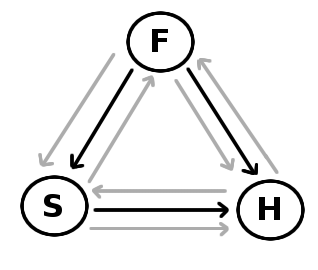
How the three are tightly functionally unified, in Swinburne’s view.

(See below for the interpretation.)

Last time we looked at Swinbure’s suggested reading of the creeds. They can’t he says, be charitably read as holding that in the same sense there’s only one divinity, and that there’s three. Swinburne comes down on the side of three. Like all social trinitarians, he’s attracted to a vision of the Trinity as being a loving community, three eternal and perfect, spirits, three selves, enjoying one another’s company, living in communion with one another, and working together in all they do. In short, he wants to say there are personal relationships internal to God – and this implies that there are persons – subjects of experience, thought, and action – in God.Read More »Swinburne’s Social Trinitarian Theory, Part 3 – functional monotheism

Swinburne’s Social Trinitarian Theory, Part 2 – a key move

(Picture credit.)

Swinburne isn’t what you’d call a theological liberal. He’s not a conservative evangelical either, given his rejection of things like biblical inerrancy. He was, I believe, a life-long Anglican, until 1996 when he converted to Eastern Orthodoxy. As I understand it, at least part of his motivation was his exasperation with anything-goes style Anglicanism (e.g. priests who are not theists). But my point is that he aims to be a “Catholic” Christian, in the sense of one who holds to mainstream orthodoxy – roughly, that core of doctrines held in common by Catholicism, Eastern Orthodoxy, and (at least in theory) most Protestants. (Actually, he’s probably a good bit more “Catholic” than that – in that he believes in apostolic succession, and in the authority of The Church to decree the meaning of scriptural texts – see his book Revelation.) This requires some dexterity on his part, and creates the burden of crafting a theory that one can claim fits with the “Athanasian” and Constantinopolitan Creeds.

Swinburne argues that it is uncharitable to read the ecumenical councils’ claim that “there is only one god” as asserting that there’s only one divine individual, as that would contradict their committment to there being three divine individuals.Read More »Swinburne’s Social Trinitarian Theory, Part 2 – a key move

Constitution Trinitarianism Part 4: pausing and revisiting some issues


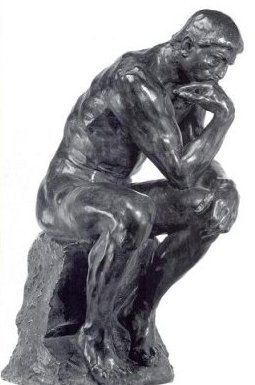
rodin1.jpg

“Come on, you tired little brain – don’t fail me now.” (No, I don’t really blog naked – serious thought requires having at least your underpants on.)

Joseph Jedwab does an excellent job (here, comments 3 & 4) pressing me for details, and taking a shot at defending the Brower and Rea theory. I wanted to chew a bit on some issues that Joseph and Ian raise before moving on, offering some corrections and other reflections. (And JT – I want to post your lengthy comment (the second one) as a guest post, so we can discuss the priority issue – email me if you object to this promotion. :-) ) Any bold type that appears in quotes here has been added by me.

To non-philosophical readers: I apologize for the over-long load of philosopher-lingo that follows. You may want to skip this one! Read More »Constitution Trinitarianism Part 4: pausing and revisiting some issues