Skip to content

Unitarianism

New Papers

I’ve just updated my homepage with a paper forthcoming in Faith and Philosophy, called “Hasker’s Quests for a Viable Social Theory.” My sincere thanks to editor Thomas Flint, and to that journal’s anonymous readers for their help. The paper critically examines the various discussions of William Hasker, a very accomplished Christian philosopher, and former editor of F&P, from whom I have learned much. I think… Read More »New Papers

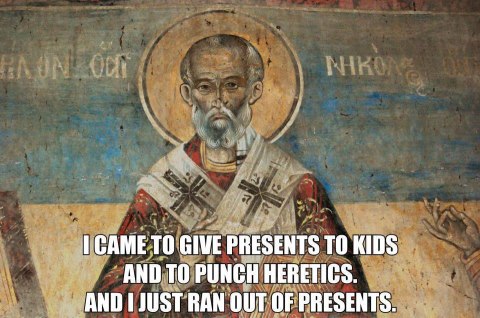
Did Santa punch out Arius?

If memes are to be believed, yes. Santa (Nicholas, Bishop of Myra) punched Arius himself in the face, at the famous council of Nicea, no less. But – I hate to tell you – memes are not always to be believed. This one’s been making the rounds online for a few years. Even Catholic philosophy professors are getting in on the fun. And it is… Read More »Did Santa punch out Arius?

You’re another!

You’re another” – that’s what tu quoque means – it’s the name of an informal fallacy, often called a fallacy of relevance. For example, if I argue that your theory is self-contradictory, suppose you retort that my theory is too. Well, so…? It’s irrelevant to the point that the first theory mentioned is self-contradictory (so, self-refuting).

Cornell grad student Chad McIntosh argues that if the social trinitarian God – or rather: the three divine persons  posited by clear “social” Trinity theories – would be deceivers, then so would the perfect self in whom I believe, being a unitarian Christian. So granting that an ST is implausible, for similar reasons unitarian Christian theology is implausible (because it has a perfect being doing what appears a wrongful deception).

Is this a defense of ST?

I’ve already argued in that paper than a Swinburne-type ST implies what looks like wrongful deception by at least one of the three divine persons. This hasn’t been disputed.

I don’t grant that if God is a single self, then Read More »You’re another!

God and his Son: the Logic of the New Testament – conference presentation

Here’s a video of my May 2012 talk in Atlanta, “God and his Son: the Logic of the New Testament.” Many thanks to Sharon and Dan Gill, who filmed, edited, and posted it on their fine website, 21st Century Reformation. The characteristic thesis of unitarian Christianity (aka Biblical Unitarianism, Christian Monotheism) is that the Father of Jesus just is the one God, Yahweh, and Jesus… Read More »God and his Son: the Logic of the New Testament – conference presentation

Further thoughts on Swinburne’s God-talk

In this 2010 post I reacted to an interview by social trinitarian Richard Swinburne. My concern was that Swinburne has a theory on which the Trinity is not itself a person, but in answer to the question “Is God a self?” He answers affirmatively. What gives? Recently a reader e-mailed me with this link (thanks, Anthony). If you look at around 14 minutes, you’ll hear… Read More »Further thoughts on Swinburne’s God-talk

Buzzard’s textual arguments against Jesus’ pre-human existence – Part 4

In this recent video, Sir Anthony makes various relevant points. As I said in part 1 of this series, his linguistic argument against “pre-existence” is not his only one. At 3:11ff he gives a version of the linguistic argument I’ve been criticizing. It seems to me that the title of this video is false. To have been “begotten of God” I think, just means to… Read More »Buzzard’s textual arguments against Jesus’ pre-human existence – Part 4

Buzzard’s textual arguments against Jesus’ pre-human existence – Part 3

Do you think that you preexisted your conception? Me neither. True, there are cultures which presuppose this. But most of the human race, including ancient Jews, assumes that getting parented involves getting brought into existence some time between the sexual union and birth. You, the younger human being, exist because of what your parents did. This, I suggest,  is the default human assumption. You exist because of them. Abe and Sarah… Read More »Buzzard’s textual arguments against Jesus’ pre-human existence – Part 3

Buzzard’s textual arguments against Jesus’ pre-human existence – Part 1

Let’s pretend that this shows Jesus at the age of 3 months. Does the New Testament teach that no more than 12 months before, Jesus came into existence (for the first time), that is, in philosopher’s lingo, that he was generated?

Sir Anthony Buzzard has argued that the New Testament teaches exactly that, and explicitly so. There’s been a boiling discussion of this argument by our intrepid commenters on this post.

I think this issue deserves some posts. In the past I’ve never been sure I’ve quite understood his argument, and so have never taken a position on it. I’m going to think through it in this series of posts.

Let us first note that the truth and reasonableness of this humanitarian unitarian christology doesn’t stand or fall with this exegetical argument. There may be other textual, theological, or philosophical reasons to hold that Christ did not exist before his human life, i.e. before his conception. It is clear to me, in fact, that this argument is not Sir Anthony’s only reason for this view. (See e.g. comment #2 in the discussion linked above.)

Second, let’s note that it is a very strong or bold argument. Read More »Buzzard’s textual arguments against Jesus’ pre-human existence – Part 1

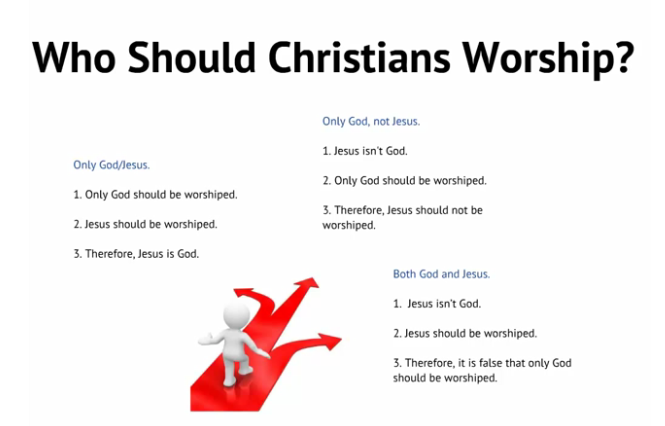
Who Should Christians Worship?

Should Christians worship only God? Or God and Jesus? Or is it redundant to say that we should worship both God and Jesus? If Jesus isn’t God himself, is it therefore the sin of idolatry to worship Jesus? I address these questions in light of scripture in this screencast version of a talk I gave in Atlanta at the 2012 Theological Conference sponsored by the Atlanta Bible… Read More »Who Should Christians Worship?

Trinitarian-Unitarian Debates – 1 Bosserman vs. Finnegan, 2008 – Part 5

Closing statements: Finnegan: 1:48:43- 1:52:12 Only one Yahweh. Jesus does things God says he can’t do, e.g. die. Jesus affirms Shema. In John 10, Jesus uses a concept of “representational deity” – i.e. calling a being who isn’t God “God” because of some likeness to God in some respect(s). Trinity is confusing, post-biblical. But it is a solution to a non-existent problem, namely, of their… Read More »Trinitarian-Unitarian Debates – 1 Bosserman vs. Finnegan, 2008 – Part 5

Trinitarian-Unitarian Debates – 1 Bosserman vs. Finnegan, 2008 – Part 4

Bosserman questions Finnegan: 1:36:20 B: Did OT saints understand that the physical Temple would be replaced by Jesus? F: No. B: So does the NT contradict the OT on this? F: Incomplete vs. contradictory claims. B: What about Deut 12? F: Like you, I think it doesn’t predict an unending physical temple. B: Why can’t God then only later reveal himself to be not only one… Read More »Trinitarian-Unitarian Debates – 1 Bosserman vs. Finnegan, 2008 – Part 4

Trinitarian-Unitarian Debates – 1 Bosserman vs. Finnegan, 2008 – Part 3

Time for mutual interrogations! This is the best part of this debate.

Finnegan questions Bosserman: 1:24:35 – 1:36:19

  • F: Was the incarnate Jesus immortal?
  •  B: Only in his divine nature. So, yes, he was.
  • F But then, he can’t die.
  • B: The human nature can.
  • F: So not God, but the impersonal human nature died?
  • B: No, Jesus died as a man; I’m no docetist.
  • F: I’m unclear on the answer then. Did Jesus die or not? If he exp’d a human death, he died, no?
Comment: Finnegan is right – the answer is totally unclear. Hence, Bosserman reaches for a red herring:Read More »Trinitarian-Unitarian Debates – 1 Bosserman vs. Finnegan, 2008 – Part 3

Trinitarian-Unitarian Debates – 1 Bosserman vs. Finnegan, 2008 – Part 2

  • Finnegan rebuttal 52:28-1:08  Back to pronouns: Bosserman’s rebuttal was unclear. Overwhelming number of pronouns and verbs re: God are singular; by the ordinary meaning of language, this communicates that he is one being. John 17 says Father is the only true God, and presupposes Jesus to be someone else. Bosserman has not answered who the first trinitarian was. And he hasn’t derived three persons and one essence from the Bible. Nor does it make sense. “Elohim” can be translated singular or plural, and needn’t refer to a plural unity. Is he saying Jesus = YHWH? If so, isn’t that modalism rather than trinitarianism. But if he’s a different “YHWH” then it seems there are two of them. “Before Abe was I am [the one]” i.e. the messiah; that’s the best way to take that saying. Believes Jesus an unfallen, sin-free human, being virgin born with God causing him. Col 1:15 doesn’t teach Jesus’ pre-existence; it’s about the new creation effected by Jesus. John 6:62 – “came down from heaven” is figurative. John 1 – can translate with “it” for “logos.” “God” in NT in over 99% of texts refers to Father. Rare in both testaments to call any human a “god.” Jesus died; God can’t. Thus they are two.

Trinitarian-Unitarian Debates – 1 Bosserman vs. Finnegan, 2008 – Part 1

Sean Finnegan is an intelligent and well spoken “Biblical Unitarian” Christian. He recently earned an M.A. in Church History from Boston University. He runs the christianmonotheism website, which aggregates work by contemporary Christian unitarians. I was pleased to meet him at a recent conference, at which he gave a fascinating presentation on how many (but not all) “church fathers” rejected the everlasting earthly Kingdom in favor of “going to heaven,” i.e. a non-bodily afterlife.

Here’s a blog post by Sean on the debate I’ll be reviewing below.

Brent Bosserman was at the time of the debate an adjunct professor at Northwest University in Washington state. I believe he’s still there, but can’t find out much about him online. But here’s a long 2007 talk of his, called “Christianity and Trinitarian Worldview.” He talks at the start about his background.

This debate suffers by not having a precisely defined debate question. While Finnegan mostly sticks to the biblical case for his view and against Bosserman’s, Bosserman pulls out a broad brush and tries to compare all-encompassing “worldviews.” This is not a good idea; a debate is finite in time!

The intros are over-long and intrusive here; I’ve skipped you to the actual start. My summaries and commentary follow.

Arguing against no one

Princeton philosopher Thomas Kelly in a paper on the epistemology of disagreement (i.e. what the reasonable response when we find the people just as smart and informed etc. as us disagree on some important matter):

In principle, we ought to be able to give due weight to the available reasons that support a given view, even in the absence of actual defenders of the view who take those reasons as compelling. But in practice, the case for a view is apt to get short shrift in the absence of any actual defenders. The existence of actual defenders can serve to overcome our blindspots by forcefully reminding us just how formidable the case is for the thesis that they defend… But the case for a given view itself is no stronger in virtue of the fact that that view has actual defenders…

Thomas Kelly, ” The Epistemic Significance of Disagreement,” p. 31 (in pre-print).

At first this reminded me of a proverb I’ve often thought of when reading some catholic theologian who has evidently never put the slightest effort into understanding the overall case for unitarianism:

“The first to speak in court sounds right–until the cross-examination begins.”  Proverbs 18:17 (NLT)

But this is actually a different point than Kelly’s. A better courtroom analogy for Kelly’s point is:Read More »Arguing against no one

The Trinity Explained (with Reason)

The word is “Therefore…” When you are making a deductive argument, this means that what you are about to say logically follows from (is implied by) what you have just said. That is, if the former part were to be true, what you’re about to say must also be true. A non sequitur (Latin for: “it doesn’t follow”) is an invalid argument, one in which the premises don’t imply… Read More »The Trinity Explained (with Reason)

Ramble on

I was interviewed a couple of times at the 2012 Atlanta Bible College Theological Conference.

Here’s the first, in which I ramble on about my own religious history and views about God, the Trinity, and Jesus.

Also: pacifism (I’m agin’ it. Perhaps the majority of conference goers, I think, were for it.) I wasn’t expecting that question – hence the rambling. 🙂

Thanks to Carlos Jimenez for filming, editing, and posting this. You can comment on the youtube page.

Better rambling below the fold…Read More »Ramble on