|
Listen to this post:
|
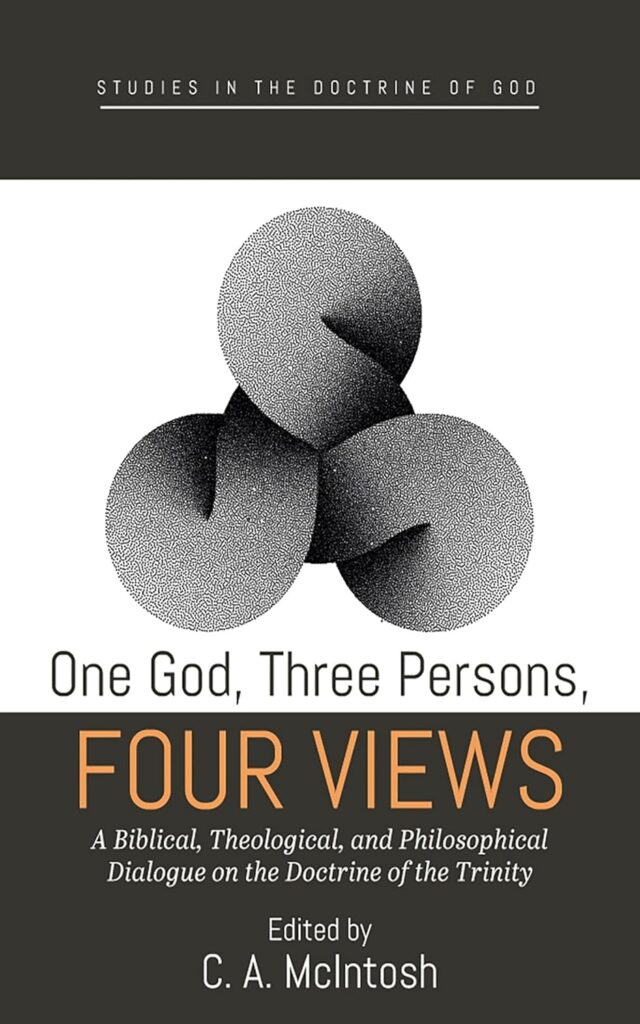
I fed Google’s NotebookLM my opening statement chapter “New Testament Theology is Unitarian” from the 2024 debate book One God, Three Persons, Four Views, edited by Chad McIntosh. Obviously, there’s no substitute for reading the original chapter (and the resulting arguments in the book – and these interactions), but NotebookLM did a great job summarizing the evidence which trinitarian apologists are utterly unprepared to answer.
Once you really see these facts, you can’t unsee them. They change the way you look at New Testament, and they show how weak arguments from the Bible to a Trinity doctrine are.
And apologists take note: do you see how these arguments are transparently NOT assuming unitarianism? If you don’t see that, you’re not paying attention.
Executive Summary: This document synthesizes the core arguments from Dale Tuggy’s “New Testament Theology is Unitarian,” which posits that the theology of the New Testament (NT) authors is fundamentally unitarian, not trinitarian. The central thesis is that the NT consistently and clearly identifies the one true God with the Father alone, a view that stands in direct contrast to later trinitarian doctrines which identify God as a tripersonal being.
The author employs a comparative methodology, evaluating two competing hypotheses against the textual evidence:
• Hypothesis T (Trinitarian): The NT authors assume the one God is the Trinity, and that the Son and Holy Spirit are fully divine.
• Hypothesis U (Unitarian): The NT authors assume the one God is the Father alone, and that neither the Son nor the Holy Spirit is divine in the same way the Father is.
The argument is built upon an analysis of twenty distinct classes of textual and historical facts (F1-F20). For each fact, the author contends that its existence would be highly surprising or unlikely if the NT authors were trinitarian (Hypothesis T), but entirely expected if they were unitarian (Hypothesis U). This consistent pattern, it is argued, provides overwhelming confirmation for the unitarian hypothesis.
Key evidence includes the complete absence of any passage defining or describing a triune God, the lack of any specific term for the Trinity, the consistent identification of “God” with the Father, the uncritical endorsement of Jewish monotheism, the unqualified presentation of Jesus as a human subordinate to God, and the ambiguous, often impersonal portrayal of the Holy Spirit. The document concludes that modern trinitarian arguments fail to account for this mountain of evidence and that a theology based solely on the apostolic writings of the NT should be unitarian.
Argumentative Framework: A Comparative Analysis
The author frames the unitarian position as a “minority report” that challenges a long-held mainstream Christian tradition. The argument acknowledges that while official creeds are trinitarian, surveys of modern laity reveal widespread non-trinitarian beliefs, suggesting a disconnect between formal doctrine and popular understanding. The text posits that the doctrine of a tripersonal God was not a required belief in mainstream Christianity until the Council of Constantinople in 381.
To avoid futile “proof-text wars,” the analysis adopts a methodology from the sciences known as the Prime Principle of Confirmation or the Likelihood Principle. This approach evaluates which of two competing hypotheses better explains a set of undeniable facts.
Competing Hypotheses
The core of the argument rests on comparing the explanatory power of two mutually exclusive hypotheses regarding the assumptions of the New Testament authors:
| Hypothesis | Core Claims |
| Hypothesis T (Trinitarian) | 1. The one God is numerically identical to the Trinity. 2. The Son is fully divine. 3. The Holy Spirit is fully divine. |
| Hypothesis U (Unitarian) | 1. The one God is numerically identical to the Father alone. 2. Neither the Son nor the Holy Spirit is fully divine in the way the Father is. |
The author proceeds to test these hypotheses against twenty classes of facts, arguing that each fact is surprising under Hypothesis T but expected under Hypothesis U, thus systematically confirming U over T.
Core Evidence: A Twenty-Point Analysis
The central evidence consists of twenty classes of facts (F1–F20) drawn from the New Testament. The analysis contends that an informed trinitarian should not deny these facts, but that their collective weight strongly favors the unitarian hypothesis.
| Fact Number & Description | Implication for Hypothesis T (Trinitarian) | Implication for Hypothesis U (Unitarian) |
| F1: No “Trinity Passage” No NT text clearly asserts, implies, or assumes that the one God is the Trinity. | Surprising: If the Trinity is a central, essential doctrine, its absence is shocking. | Expected: If God is the Father alone, no such passage would be written. |
| F2: No Trinitarian Language The NT authors had no word (trias, trinitas) or specific phrase for a tripersonal God. The word “God” (theos) overwhelmingly refers to the Father. | Surprising: It is shocking that authors believing in a triune God would lack any term to refer to it. | Expected: No term is needed for a non-existent concept in their theology. |
| F3: Clear Identification of God as Father The NT clearly and frequently assumes the one God is the Father (e.g., John 17:1-3, 1 Cor. 8:6), but never clearly assumes God is the Trinity. | Surprising: The explicit identification of God with the Father would be misleading if God is actually the Trinity. | Expected: The texts state the unitarian view directly. |
| F4: Endorsement of Jewish Theology Jesus and the apostles endorse core Jewish monotheism (e.g., Mark 12:28–34) without any correction or clarification about multiple divine persons. | Surprising: A golden opportunity to correct a supposedly “too-restrictive” monotheism is missed. | Expected: Their theology of God was the same as their Jewish contemporaries. |
| F5: No Early Monotheism Controversies There is no record of first-century non-Christian Jews accusing the early Christians of polytheism or compromising monotheism. | Surprising: Jewish opponents, who criticized many other points, would surely have attacked a trinitarian deviation from monotheism. | Expected: There was no controversy because there was no theological disagreement on who God is. |
| F6: Usage Pattern of “God” (theos) Over 99% of the uses of theos refer to the Father. It never refers to the Trinity and only rarely (and arguably) to Jesus or the Spirit. | Surprising: One would expect a more even distribution of the title “God” among three equally divine Persons. | Expected: The main word for God is used for the one who is God. |
| F7: Pattern of Worship Worship is directed to the Father, through Christ. The Trinity and the Holy Spirit are never objects of worship in the NT. | Surprising: Trinitarian practice involves worshiping all three Persons and the Trinity as a whole. | Expected: Worship is directed to the one God, the Father. Worship of the man Jesus is directed “to the glory of God the Father” (Phil. 2:11). |
| F8: Stylistic Name-Swapping Authors stylistically swap co-referring terms like “God” and “the Father” (John 6:45-46), but never swap “God” with “the Son” or “Christ.” | Surprising: If “God” and “the Son” were co-referring in some sense, stylistic swapping would be expected. | Expected: Terms are swapped only when they refer to the same individual. |
| F9: God-Terms are Singular & Personal All terms for God are grammatically singular and used with singular personal pronouns, verbs, and adjectives, presenting God as a single self. | Somewhat Surprising: Trinitarianism involves complexity about God being one and three, a “he” and a “they,” which is absent from NT grammar. | Expected: God is a single self (the Father), so singular personal language is used. |
| F10: Usage of “the Lord” (ho kurios) The title is applied to God (Yahweh) and to the exalted Jesus, but never to the Holy Spirit or the Trinity. | Surprising: If the Spirit and Trinity were also “Lord” in the divine sense, one would expect the title to be applied to them. | Expected: The title is used for God and for the man God made “both Lord and Messiah” (Acts 2:36). |
| F11: The Gospels’ “Big Reveals” The climatic confessions in the Gospels are that Jesus is the Messiah/Son of God (e.g., Matt. 16:16, John 20:31), not that he is God or a divine person of the Trinity. | Surprising: The authors pointedly omit what trinitarians consider the most important facts about Jesus. | Expected: The authors state their main theses clearly. |
| F12: Jesus is Called “a Man” Jesus is frequently called “a man” (anthropos) with no qualification or warning that he is not a “mere man” (e.g., Acts 2:22, 1 Tim. 2:5). | Surprising: Trinitarian authors are typically careful to qualify this language to avoid misinterpretation. | Expected: The authors call him a man because they believe him to be a man. |
| F13: Human Titles & Portrayals of Jesus Jesus is unselfconsciously called a prophet, a servant, and a descendant of David, and is portrayed with human limitations (ignorance, temptation, prayer). | Surprising: Presenting Jesus with these limitations without explaining how they are compatible with full deity is misleading. | Expected: These portrayals accurately reflect the authors’ understanding of Jesus as a human being. |
| F14: Jesus’s Power is Derived Jesus’s mission, power, authority, knowledge, and kingdom are consistently described as having been given to him by God. | Surprising: A fully divine being would not need to receive these things but would possess them by nature. | Expected: As God’s human agent, Jesus is empowered by God for his mission. |
| F15: Unqualified Implications of Limits NT texts imply Jesus is less than God in power, knowledge, goodness, and authority, without any qualification (e.g., “in his human nature”). | Surprising: Such stark comparisons would be highly misleading if Jesus were co-equal with the Father. | Expected: The statements accurately reflect a relationship of subordination. |
| F16: The Father is Jesus’s God The NT clearly and repeatedly states that the Father is the God of Jesus (e.g., John 20:17, Eph. 1:17, Rev. 3:12). | Surprising: Full deity seems to preclude having a god over oneself. | Expected: Jesus, as a man, worships and serves the one true God, the Father. |
| F17: Usage of “God the ____” The phrase “God the Father” appears in the NT, but “God the Son” and “God the Holy Spirit” do not. | Surprising: If all three are equally God, the absence of parallel constructions is strange. | Expected: The phrase “God the Father” is used because the Father is God. |
| F18: No Interest in Eternality The NT authors show no concern for asserting the eternality of the Son or the Spirit, a key tenet of later Nicene orthodoxy. | Surprising: Given the opportunity (e.g., birth narratives), the authors offer no warning against concluding Jesus began to exist. | Expected: If they did not believe the Son/Spirit were eternal beings, they would have no reason to assert it. |
| F19: The Holy Spirit Not a Clear Self The Spirit is more often described impersonally (wind, fire, power) and lacks the clear personal characteristics of the Father and Son (never prayed to, has no throne, sends no greetings). | Surprising: The third divine Person is a faint and ambiguous character, unlike the other two. | Expected: The “spirit of God” is presented as God’s power or presence, not as a separate self. |
| F20: Nature of “Triadic” Passages Passages mentioning Father, Son, and Spirit (e.g., Matt. 28:19, Eph. 4:4-6) are rare and do not conform to later trinitarian formulas. They are better explained by the unitarian plot of the NT. | Somewhat Surprising: The passages lack the precision and structure one would expect from trinitarian authors. | Expected: The key agents of salvation—God, his Son, and his empowering spirit—are naturally mentioned together. |
Critique of Trinitarian Arguments
The author addresses and refutes common arguments made in favor of a trinitarian reading of the New Testament.
The Developmental or “Trajectory” Argument
One counter-argument suggests that the NT authors were “not full-blown trinitarians” but were on a trajectory toward that view. The text refutes this by arguing:
1. Even a “half-blown” trinitarian view is still a form of Hypothesis T, and the twenty facts presented weigh just as heavily against it.
2. The alternative—that the authors are not trinitarians at all—is exactly the author’s point. They are presented not as confused or searching, but as having a clear and consistent unitarian theology.
The Modern “Biblical-Trinity Argument”
A popular deductive argument for the Trinity is analyzed and found to have fatal flaws. The argument is typically formulated as follows:
1. The NT teaches that:
? (i) The Father is God.
? (ii) The Son is God.
? (iii) The Holy Spirit is God.
? (iv-vi) The Father, Son, and Spirit are distinct from one another.
? (vii) There is only one God.
2. To teach (i)-(vii) is to teach the doctrine of the Trinity.
3. Therefore, the NT teaches the doctrine of the Trinity.
The author critiques this argument on three grounds:
• Premise 2 is False: The seven points are an over-simplification. They make no mention of a tripersonal God, which is the “signature idea of any Trinity theory,” nor do they include concepts like “generation” and “procession” which are central to historic creeds.
• Premises (i)-(iii) are Ambiguous: The phrase “is God” can be interpreted in multiple ways. A subordinationist unitarian could agree that all three are divine, but in different senses, with the Father alone being the one true God. A modalist could also agree, interpreting the Father, Son, and Spirit as modes of the one God. The argument’s premises are not uniquely trinitarian.
• The Argument Omits Key NT Data: The argument conveniently omits the clear NT teaching (Fact F3) that the “one God” of premise (vii) is numerically identical to the “God” (the Father) of premise (i). By explicitly identifying the one God with the Father alone, the NT authors do not leave open the possibility of identifying God with a Trinity.
Conclusion: Theological Authority and Implications
The document concludes that the cumulative weight of the twenty facts provides an overwhelming case that the New Testament authors operated with a unitarian theology. Any attempt to derive a Trinity theory from the NT is described as hanging from a “precarious chain of reasoning” based on a small and often unclear selection of texts, while ignoring the broader witness of the scriptures.
The core teaching of the NT, according to this analysis, is that the one true God is the Father himself. This is presented not as a peripheral point but as a central claim of God’s self-revelation. The final implication is a challenge regarding one’s primary theological authority. If authority rests in the apostolic writings of the New Testament, the resulting theology should be unitarian. Conversely, adherence to trinitarian doctrine requires elevating later ecclesiastical authorities—such as the Pope, councils, or other traditions—above the plain teaching of scripture.
