Podcast: Play in new window | Download
Subscribe: Spotify | Email | RSS
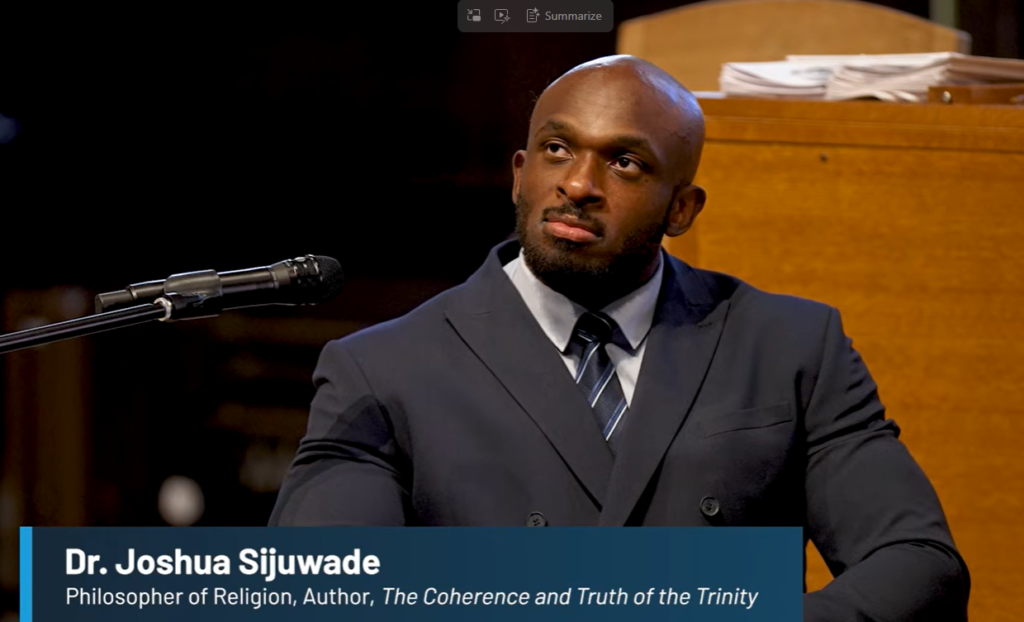
This episode is part one of my review of my July 2026 debate with Dr. Joshua Sijuwade. (Video version here.) It consists of his 35-minute opening statement, with my comments and critique.
He spends the bulk of it arguing that what he calls “Conciliar Trinitarianism” best explains New Testament teaching about God, his Son, and his spirit.
He then argues that this theology, or something much like it, was taught by the second and third century “church fathers,” such as Justin, Tertullian, and Origen.
Finally, he argues that this is the teaching of the “ecumenical” church councils.
Some notable things in my discussion include: my critique of traditional rhetoric about the Son being “on the Creator side of the Creator-creature divide,” the utter lack of scriptural support for the eternal “procession” of the Holy Spirit, and the meaning of Dr. Sijuwade’s talk of a “relational distinction” when it comes to the Father and the Son.
Auto-generated chapter marks:
0:29 Debate Review Starts
3:24 Defining Conciliar Trinitarianism
9:56 Best Explanation Claims
17:20 The Five Pillars
19:38 Father as the One God
22:33 The Son and Preexistence
42:29 The Spirit and Procession
55:20 Identifying God’s Marks
59:59 Jesus Bears Divine Names
1:05:33 Jesus Has Divine Attributes
1:12:24 Jesus Creates All Things
1:22:55 Thrones and Worship
1:32:00 Explaining the Evidence
1:43:56 Fathers and Councils
2:04:05 Creed of 381
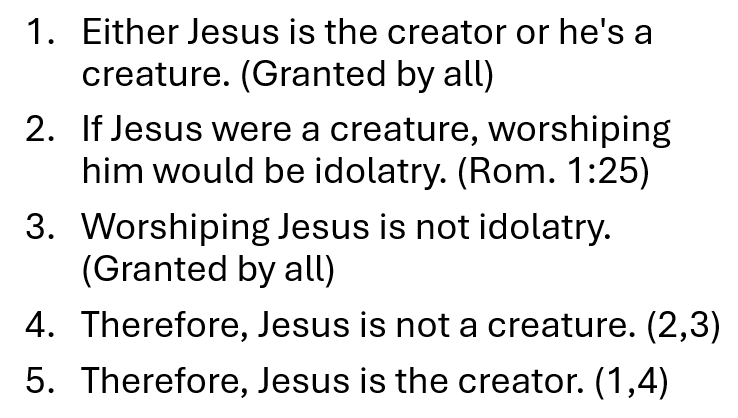
Along the way I critique this argument for Jesus being the creator.
Links for this episode:
The original video produced by the Unitarian Christian Alliance and Premier Unbelievable.
Tuggy, Monotheism, Heresy, and the Bible
J.N.D. Kelly, Early Christian Theology
How John 1 was intelligible in the first century
podcast 63 – Thomas Belsham and other scholars on John 8:58
Hebrews 7:3 @ biblicalunitarian.com
Kapusta, Scripturae Contra Trinitatem – The Epistle to the Hebrews: An Anthology of Quotations, Alternative Expositions, and Critical Commentaries on Common Trinitarian Proof-Texts
Does Colossians 1:16 Refer To The Old or New Creation? Sean Finnegan at UCA UK Conference
podcast 227 – Who Should Christians Worship?
Gaston, Dynamic Monarchianism: The Earliest Christology?
Origen on the Challenge to Jesus is God Apologists
trinitarian or unitarian? 7 – Origen uncensored
“the Holy Trinity, the one God” at the Orthodox Council of Blachernae held in 1285.
This week’s thinking music is “Sun Moon Stars and You INST” by Cillek.
AI-generated summary:
In this episode we begin a detailed review of a debate on whether Conciliar Trinitarianism is biblical and orthodox. We explain that the discussion will be analyzed slowly, with attention to historical claims, proof texts, and the debate strategy itself.
We summarize the definition of Conciliar Trinitarianism as presented in the debate: one God, identified with the Father, and two relationally distinct divine persons, the Son and the Spirit, who share the same divinity as the Father. We note that the case is framed as an inference to the best explanation, using simplicity, explanatory power, fit with background knowledge, and unification.
We then work through the biblical arguments for the Son, focusing on John 1, John 17, Philippians 2, and Hebrews 7. We explain that we dispute readings that treat the Logos as the same as the preexistent Son, and we argue that these passages are better read in terms of personification, agency, exaltation, or disputed preexistence language rather than full deity.
We next turn to the Holy Spirit, discussing texts such as John 15, John 14, Romans 8, Acts 13, and 1 Timothy 5. We note the claim that the Spirit is a distinct person and fully divine, but we also stress that personal language about the Spirit does not by itself establish a third divine person.
We then summarize the appeal to Jewish monotheism, divine identity, and the five categories of names, attributes, actions, rulership, and devotion. We review the use of early Christian writers and councils, while arguing that the historical evidence is mixed and often reflects subordinationist or modalist views rather than later conciliar Trinitarianism.

Related posts:

podcast 68 - Dr. Harriet Baber on Relative Identity and the Trinity

Is God a Self? Part 2 - Flint

Jesus and “god” - part 11 - Review and Conclusion

the evolution of my views on the Trinity - part 3

Congratulations to J.T. Paasch (Dale)

Islam-Inspired Modalism - Part 2

Arius and Athanasius, part 2 - Producing something with 'ingredients' (JT)

podcast 293 - Dr. Jo-Ann Brant on the Gospel According to John - Part 1

podcast 258 - Who is the one Creator? - Part 1